referências do tema “Games for Change”
Canal de you2be: comunidade/conferência “Games for Change” – LINK
acerca de probabilidades
referências acerca de probabilidades em jogos, com exemplos de jogos de tabuleiro..
Probability Examples and Solutions
Novos Talentos FNAC 2024

Este ano os vencedores dos Novos Talentos FNAC 2024, na categoria de videojogos foram:
Vencedor – Bruno Kuipers, “WhileAwayGame”
Menção honrosa – Solange Margarido, Daniel Margarido, Guilherme Silva, Beatriz Araújo (“Codename: GOD”)
Menção honrosa – Guilherme Gama e Bruno Mascarenhas (“Beyond The Board”)
“WhileAwayGame”
“Codename: GOD”
“Beyond The Board”
Este anos o júri foi composto por:
Ricardo Fontes, João A. de Matos, André Santos e Miguel Dias
+infos(oficial): LINK
Humble Software Bundle (campanha)
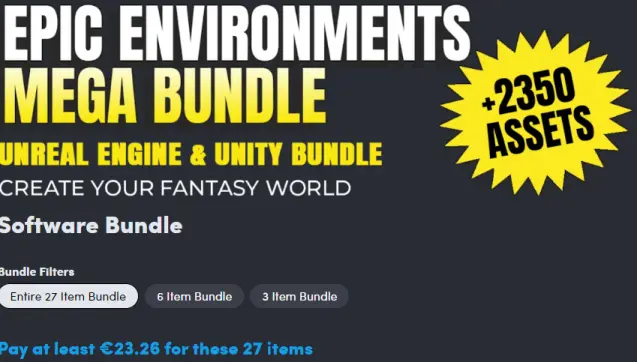
Uma campanha com vários ficheiros de ambientes gráficos, personagens, para o Unreal e alguns (poucos) para o Unity, “Epic Environments Mega Bunde Unreal engine & Unity Bunde Create your fantasy world“ em que:
“Bring the fantasy world of your dreams to life in your Unity or Unreal Engine game project with this massive bundle of assets! From bustling medieval urbanscapes to ancient temple environments teeming with mystery and majesty, you’ll get tons of modular assets with which to craft play spaces that’ll enchant and transport your players. Also included are a host of characters and props to help make your environments feel convincing and lived-in”.
Da lista faz parte:
“Modular Medieval Environment
Ancient Temple Environment
Mountain Grassland Environment 2×2 km
Medieval Street Pack
Fantasy Giant’s – Modular Male with Randomization
Northern Island Pack 4×4 km
Forest Environment
Lake Houses Pack
Medieval Castle Environment
Medieval Tents & Camping Props Pack
Medieval Village Houses Pack
Medieval Village Megapack with Interiors
Medieval Windmill with interiors
Procedural Oak Forest
Modular Ancient Temple Environment – UNITY
Medieval Village Megapack with Interiors – HDRP – UNITY
Medieval Street Environment – UNITY
Modular Sorcerer – Male Humans – Fantasy Collection
Mercenary – Medieval Female Set
Mercenary – Male Humans – Fantasy Collection
Undead Knight 01 – Draugr Undead Zombie Monster Set
Medieval Village Props Package
Modular Middle Eastern Village Environment
Medieval Village Megapack with Interiors – UNITY
Old Village Houses Pack
Ancient Cave Ruins
Corpse Bandit – Draugr Undead Zombie Monster Set”
+infos(oficial): LINK
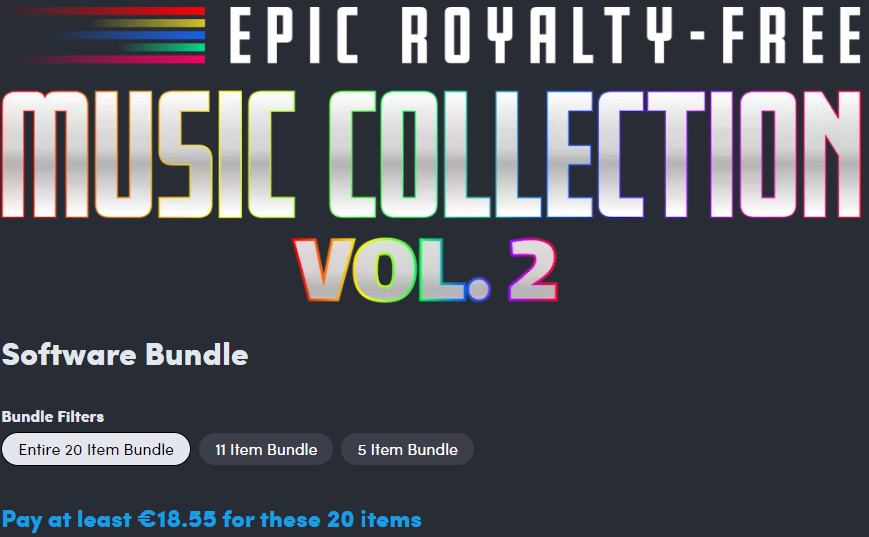
Uma campanha com vários ficheiros de áudio que podem ser usados de forma gratuita, “Epic Royalty-free Musica Collection vol.2“ em que:
“Looking for the perfect soundtrack to accompany your next project? Composer Joel Steudler invites you on a sonic journey with this colossal collection of royalty-free music from his intensive catalog! From entrancing synthwave to bombastic tunes perfect to make an impact in your trailer, this collection is packed with tracks suitable for films, games, or whatever you’re working on!”.
Synthwave
lofi Vapor
Sci-Fi Cyberpunk
Sci-Fi Orchestronica
Guitar Energy
Neoclassical Strings
Piano Moods
Retro Games
Trailer Power Vol 2
Trailer Power Vol 1
Hollywood Action
Devious Dramedy
lofi Chill
Medieval
World Traveller
Cinematic Drama
Fantasy Atmosphere
Horror Atmosphere
Powerful Percussion
Sci-Fi Atmosphere
”
+infos(oficial): LINK
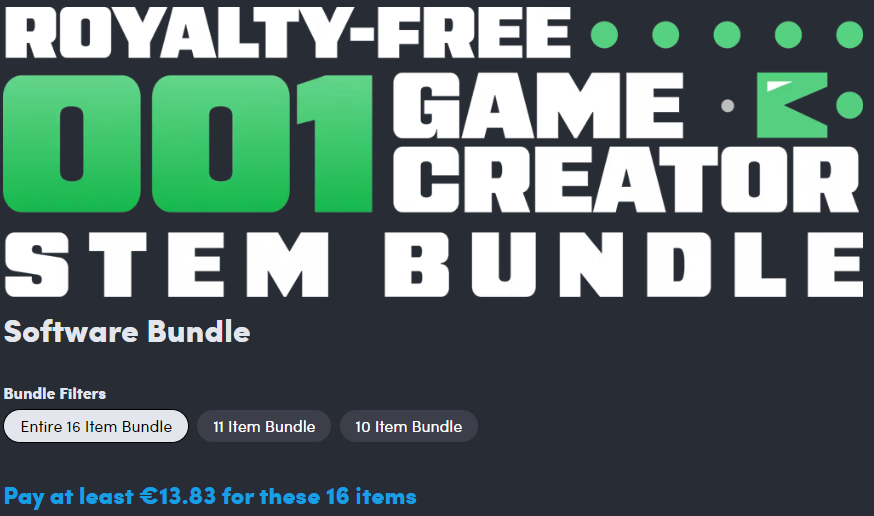
Uma campanha sobre a documentação de suporte para o desenvolvimento de videojogos, “Royalty-free 001 Game Creator Stem Bundle“ em que:
“Dream of creating a game but don’t know where to start? 001 Game Creator is here to help you bring your ideas to life! This powerful, versatile, and easy to use game engine employs graphically assisted scripting to get your concepts in motion quickly without any prior coding knowledge. Get access to the engine, along with full-featured expansion kits for a variety of game genres that’ll give you a valuable head start on your projects! You’ll also get a wealth of tutorials to teach you the ropes, plus a collection of handy worksheets to help get your designs and concepts in shipshape.”.
e da lista surgem:
001 Basics E-Book + E-Learning Home Assignments
001 Resource E-Book + E-Learning Home Assignments
001 Game Creator – Point & Click Adventure
001 Game Creator – Visual Novel
001 Game Creator – Step Dungeon Maze Kit
001 Game Creator
SoftWeir Game Design Documentation Builder
SoftWeir Project Management Documentation
SoftWeir World Design Worksheet
SoftWeir Map & Dungeon Design Worksheet
SoftWeir User-Interface Design Worksheet
SoftWeir Character & Animation Design Worksheet
SoftWeir Story & Storyboard Design Worksheet
SoftWeir Script & Logic Design Worksheet
SoftWeir Item Design Worksheet
SoftWeir Weapon & Armour Design Worksheet
”
+infos(oficial): LINK
POLYGON assets, para Unity e Unreal (promoções)
De vez em quando dou um salto ao web site da Synty® Studios para ver as novidades e possíveis promoções. Vou deixar aqui este post para verificar como anda o histórico das promoções destes assets:

POLYGON – War Pack, 58.23 euros
+infos(oficial): https://syntystore.com/products/polygon-war-pack
POLYGON MINI – Fantasy Pack, 11.64 euros
+infos(oficial): https://syntystore.com/products/polygon-mini-fantasy-pack
POLYGON MINI – City Pack, 11.64 euros
+infos(oficial): https://syntystore.com/products/polygon-mini-city-pack
POLYGON – War Map – WWI, 14.57 euros
+infos(oficial): https://syntystore.com/products/polygon-war-map-wwi
POLYGON – Dungeons Map, 87.37 euros
+infos(oficial): https://syntystore.com/products/polygon-dungeons-map
Livros em destaque em maio’2024
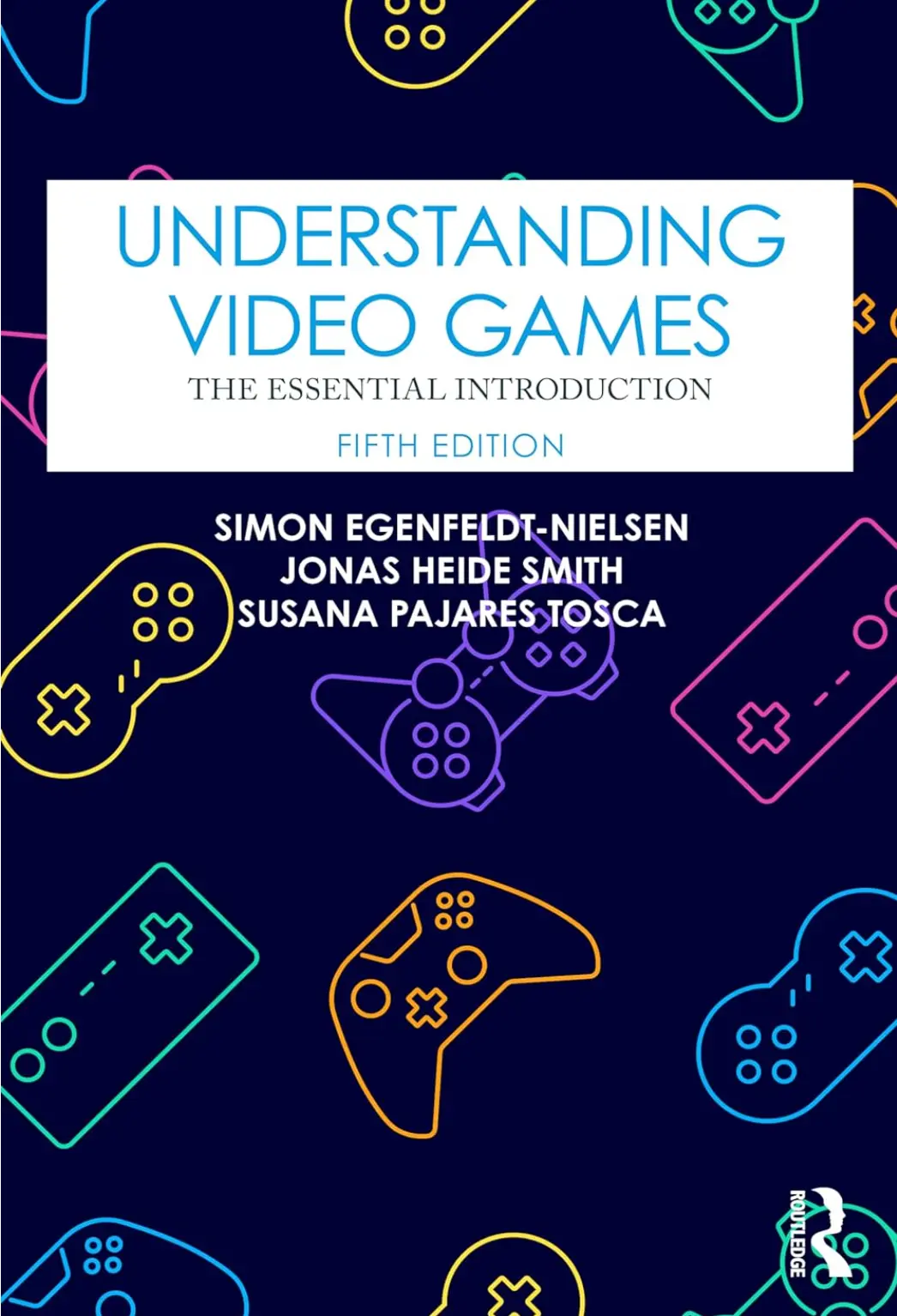
Understanding Video Games 5th Edition por Simon Egenfeldt-Nielsen, Jonas Heide Smith e Susana Pajares Tosca
”
The fifth edition of this pioneering textbook takes video game studies into the next decade, highlighting changes in mobile, social, and casual gaming.
This book introduces students to both the major theories used to analyze games, such as ludology and narratology, and the commercial and organizational aspects of the game industry. Drawing from historical and contemporary examples, this student-friendly text also explores the aesthetics of games, evaluates the cultural position of video games, and considers the potential effects of both violent and “serious” games. This new edition includes updates to the history, statistics, and developments in the vast game studies landscape throughout. The book has been expanded with additional theory, research, and insights from scholars around the world, making it more inclusive and broadening its global perspective.
Extensively illustrated and featuring discussion questions, a glossary of key terms, and a detailed video game history timeline, Understanding Video Games, Fifth Edition is an indispensable resource for anyone interested in examining the ways video games are reshaping entertainment, education, and society.
”
Um livro a ler, deve ter algumas histórias bem interessantes.
+infos(amazon): LINK
Humble Software Bundle (campanha)
Uma campanha de assets para jogos low poly, “LowPoly Game Dev Bundle“ em que:
“Nail the evocative retro look of the 32-bit era in your next project with this bundle of low-poly game assets, usable on Unity, Unreal, and other game engines big and small! You’ll get thousands of individual assets across dozens of themed packs, allowing you to create everything from awe-inspiring futuristic space colonies, to post-apocalyptic ruins teeming with hazard—plus, all the props you need to bring them to life! Everything in this bundle is in FBX format, so you’ll be able to integrate it all seamlessly, regardless of your workflow.”.
e da lista surgem:
Low Poly Sci-Fi Pack
Post Apocalyptic Low Poly Pack
POLY – Nature Pack
POLY – Mega Construction Kit
POLY – Mega Survival Kit
Western Low Poly Pack
War Low Poly Pack
POLY – Survival Vehicles Modular
POLY – Survival Subway
POLY – Sci-Fi Sandbox Kit
POLY – Military Shooting Range
POLY – Megapolis City Pack
POLY – Mega Weapons Kit
POLY – Mega Survival Tools
Pirate Low Poly Pack
Low Poly Terrain Pack
Low Poly Modular City Pack
Horror Low Poly Pack
Futuristic Low Poly Pack
Forest Low Poly Pack
Winter Environment Low Poly Pack
Survival Low Poly Pack
POLY – Wild West
POLY – New York City Modular
POLY – Mega Survival Melee Weapons
POLY – Mega Survival Food
POLY – Mega Medical Kit
Low Poly Interior Pack
Food Low Poly Pack
Fantasy Low Poly Pack
Vehicle Low Poly Pack
Sci-Fi Weapons Low Poly Pack
POLY – Lite Survival Forest
POLY – Lite Survival Collection
POLY – Houses
Low Poly Planets Pack
”
+infos(oficial): LINK
Uma campanha de assets para jogos do género RPG intitulada “Gamedev Market’s RPG Adventure essentials“ em que:
“Game makers, get ready to supercharge your 2D creations with this massive bundle, overflowing with pixel-perfect assets ready to drop into your next project! You’ll get dozens of versatile tilesets, from somber cyberpunk cityscapes to idyllic medieval villages, allowing you to bring the worlds in your imagination to life. Populate them with a vast array of diverse characters, fearsome monsters, and charming critters, and add the finishing touches with slick icon packs, sound effects, and retro-inspired music.”.
e da lista surgem:
Medieval Fantasy SFX Bundle
2D Customisable Characters For Unity
Ultimate RPG Music Collection
Omega Modern Graphics Pack
Cyberpunk Tileset For RPGS
High School Tileset For RPGS
Modern Interiors Tilesets For RPGs
Modern Tileset For RPGS
2D Icons Total Pack
2D Icons Picto Total Pack
Retro Game SFX Bundle
Sci-Fi Frontiers Tileset For RPGS
Admurin Items Mega Pack A
Monster Mega Pack B
Sci Fi RPG Tiles and Characters Pack
Perspective RPG Top Down 8×8
Demonic Dungeon RPG Top Down 16×16
Farming Character Sprites
Interior 16×16 Tileset
Fortress 16×16 Tileset
Grasslands 4 Seasons 16×16 Tileset
Village & Winter Village 16×16 Tileset
Forest 4 Seasons 16×16 Tileset
Frozen Caves 16×16 Tileset
Dark Castle 16×16 Tileset
Magma Dungeon 16×16 Tileset
Cellar 16×16 Tileset
Mountains & Winter Mountains 16×16 Tileset
Houses & Winter Houses
Abandoned Mines 16×16 Tileset
2D Hand Painted Extra Objects Tileset
2D Pixel RPG Icon Pack
RPG Casual Weapon
Mini Medieval 8×8
2D Hand Painted Interior Tileset
2D Hand Painted Grassland Tileset
2D Hand Painted Town Tileset
Micro Venture RPG Top Down 4×4
Another Perspective RPG Top Down 8×8
Animals RPG Sprites
Demonic Dungeon Frozen Cavern RPG Top Down 16×16
Demonic Dungeon Haunted Temple RPG Top Down 16×16
Mini Medieval Kingdom Interior 8×8
Mini Medieval Arctic 8×8
Mini Medieval Ocean 8×8
Mini Medieval Desert 8×8
Radiant Dungeon 16×16
Animals RPG Sprites 2
Pixel Animations and Effects Pack
”
+infos(oficial): LINK
Uma campanha para a aprender a trabalhar com o Godot com o titulo “Learn to Make Games in Godot 4.0 – GameDev.TV“ em que:
“Been sitting on your game dev ambitions? Jump on this bundle of online courses from GameDev.tv, packed with expert instruction on the skills you need to develop both 2D and 3D games using Godot 4. Learn the fundamentals of game mechanics, animation, scripting, and more with courses dedicated to both 2D and 3D game development. Spread your wings with specialized courses covering topics like C#, multiplayer and mobile game development, and more”.
e da lista surgem:
Complete Godot 2D Course: Develop Your Own 2D Games Using Godot 4
Complete Godot 3D Course: Develop Your Own 3D Games Using Godot 4
Godot 4 C# Action Adventure Course: Build your own 2.5D RPG
Godot 4 Multiplayer Course: Make Your Own Online Game – EARLY ACCESS
3D Dungeon Tileset & Asset Pack
Arcane Accessories 3D Asset Pack
Dungeon Expedition Essentials 3D Asset Pack
Master Mobile Game Development with Godot 4 Course: From Concept to App Stores
Godot Game Controller
Godot 4 Shaders Course: Craft Stunning Visuals
”
+infos(oficial): LINK
Uma campanha de assets para ajudar no desenvolvimento de videojogos, com o titulo “Unreal and Unity Assets Giga Bundle – Leartes Studios“ em que:
“Game devs, get ready—this mind-blowing bundle is about to exponentially explode the quantity of creative options at your disposal. Inside you’ll find dozens of asset packs, tools, and more, for Unreal Engine and Unity, ready to plug into your projects and accelerate your process of game creation. You’ll get a vast array of 3D models, textures, and interactive elements to help you craft stunning environments, from post-apocalyptic settings, to vibrant urban landscapes. Also included are fully-rigged characters and creatures, drivable and animated vehicles, sound and visual effect packs, and much, much more”.
e da lista surgem:
Military Base Megapack
Steampunk Victorian Megapack
Industrial Harbour
Dark Medieval Megapack
Ultimate Level Art Tool
CyberPunk Laboratory
Roman Temple Ruins
Havana Street Environment
Old Workers Village
Baroque Cathedral Environment
Fighting Stage Environment
Abandoned Chemisty Classroom
CyberPunk / Sci – Fi Apartment Interior
Stylized Christmas Town
Island Castle Environment
Stylized Countryside House
Stylized Cyberpunk Arcade
Stylized Wizard Room
Warzone VFX Pack (Unreal Engine)
Post Apo Diner SFX
SFX Soulslike
Driveable / Animated Construction Truck 02
Driveable / Animated Construction Truck
Driveable / Animated Excavator ( Material Variations )
City Scooter – Rigged/BP Controllable w/Skins
Military Helicopter – Rigged/BP Controllable w/skins
Cyberpunk Holograms / Neon Set ( Set of 33 Holograms )
Military Exterior Pack
Cyberpunk Assault Rifles
SUV 01 Driveable / Animated / Realistic
Classic Limousine / Driveable / Functional
Playground Equipment VOL.2
Playground Equipment VOL.1
Western Town Environment
Bowling Alley
English Cottage Interior
Wetland Sanctuary Environment
Office Corridor Environment
French Quarter Street
Motorbike Shop Environment
Stylized Desert Town
VFX Explosion (Unreal Engine)
SFX Retro Police Station
FPS 4K Custom Modern Handguns – VOL.1
(5) FPS 4K Custom Modern Shotguns – VOL.1
Post Apocalyptic Melee Weapons VOL.4
Driveable / Animated Excavator / Dozer ( Material Variations )
Police Character / NPC
1950s Businessman / Mafia Character / NPC / Rigged
Material Assignment Tool
Cyberpunk Street Lights
Classic Tram / Functional
Driveable / Animated Retro Cyberpunk Hover Car 02
Modeling Tutorial
Stable Environment
Stylized Cavern Mahal Environment
Water VFX (Unreal Engine)
SFX Warzone
Object Distribution Tool
Unreal Engine 5 Level Tutorial 1 (Time lapse tutorial)
”
+infos(oficial): LINK
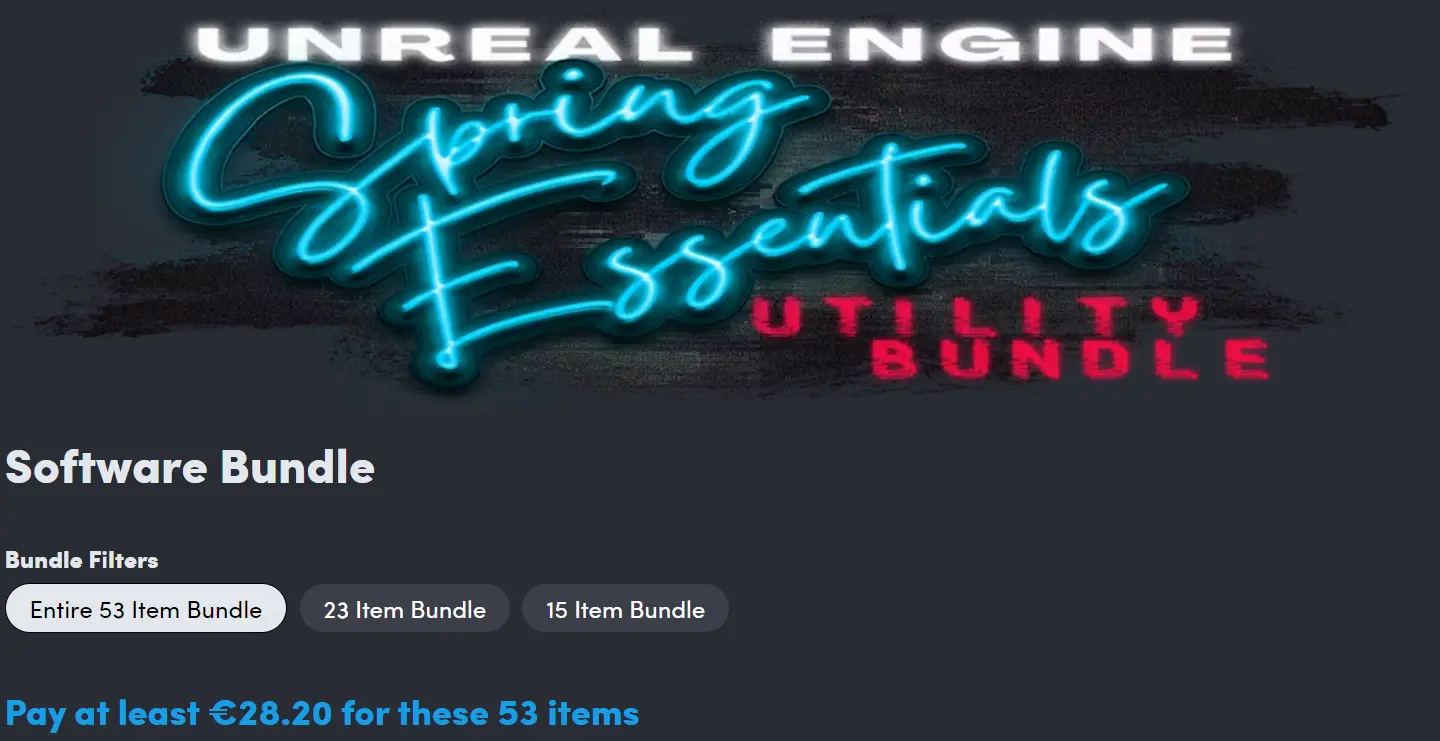
Uma campanha de assets e ferramentas para ajudar no desenvolvimento de videojogos no Unreal, com o titulo “Unreal Engine Spring Essentials – Utility Bundle“ em que:
“Game devs, are you ready to take your Unreal Engine project to the next level? This extensive collection offers a diverse array of assets and tools touching virtually every facet of game creation. You’ll get a dizzying array of ready-to-use Unreal Engine assets, redeemable on the Unreal Marketplace. With new and existing releases from Yarrawah Interactive, Dekogon, Freshcan3D, Mocap Online, Meshingun, Iraisynn Attinom, Night Times, BVG, SERLO, Jumpzoid and Maksim3D!”.
e da lista surgem:
Realtime Designer: Lighting Kit
Ultra Volumetrics
Survival NPC – Sarah “Sal” Jacobs
Critters VOL.2 – Crows & Seagulls (Nanite and Low Poly w/Particle)
FPS Automatic Rifle 01 Animations
Intelligent Traffic System
Buildings VOL.8 – Commercial Doors (Nanite & Low Poly)
Leclerc AMX56 – Advanced Tank Blueprint
Barnyard Megapack (Barn, Barn Props, Farm Environment)
Stylized Domes Shader
Foliage VOL.6 – Broom Bushes (Nanite and Low Poly)
Foliage VOL.11 – Bushes (Nanite and Low Poly)
Foliage VOL.8 – Dead Trees (Nanite and Low Poly)
Procedural Oak Forest (Winter Forest, Spring Forest, Autumn Forest)
Mobility Basic – MoCap Pack
Boxing – MoCap Pack
Rifle Basic – MoCap Pack
Pistol Starter – MoCap Pack
Foliage Pack
Echoes of Adventure: Set 2
Audio Odyssey: Vol. 2
Ambient Systems – Loop Set: Vol. 2
Ambient Systems – Loop Set: Vol. 3
FPS Pistol And Knife Animations
Stylised Barrier Shader
Foliage VOL.10 – Yard Plants (Nanite and Low Poly)
Foliage VOL.7 – Ash Trees (Nanite and Low Poly)
Russian T-55A Battle Tank – Advanced Tank Blueprint
Two Pack – Blacksmith & Knight – Male Humans – Fantasy Collection
Book Generator
56 Animations For Creatures
Blutility Production Tools – Material Functions
Termite Mounds – Vol 1
Modular Suburban Metal Fence
First Person Base Arms Vol. 1 – Skinny Male
Dry Animal Bones – Photoscan Vol 2.
Animal Dung/Feces – Horse and Cow – Photoscan Vol 3.
Flag Generator
Cardboard Props Vol1
Echoes of Adventure: Vol 1
Audio Odyssey: Vol. 1
Ambient Systems – Loop Set: Vol. 1
FPS Automatic Gun Animations
Weapon And Shield Animations
Hologram Shader
Developer Tools
Fences VOL.2 – Farm and Town Modular (Nanite and Low Poly)
Foliage VOL.9 – Coyote Bushes (Nanite and Low Poly)
Buildings VOL.5 – Doors (Nanite and Low Poly)
Toolset Collection – Vol 1.
Desert Embankments – Photoscan Vol 4.
Warrior – Viking Male Set
”
+infos(oficial): LINK
Ofertas de trabalho (em maio)
Procura-se um Game Designer (Setubal/Portugal) pela Kwalee, no modo hibrido, em que:
“As Game Designer you will be creating fun, exciting mobile game experiences with creative input from the initial pitch to the global launch. You will work closely with our design and mobile games teams and report to our Lead Game Designer.
Responsibilities
Working as part of the design team, taking responsibility for multiple mobile game projects, from an initial pitch all the way to global launch.
Keeping track of market trends and coming up with game ideas that will be well received by the ever-changing hybrid casual gaming audience.
Designing compelling game mechanics using modern mobile design principles. Creating, balancing and tuning game mechanics, game difficulty and UI flow.
Creating levels and additional content using Unity, for new and existing games.
Evolving and adapting game designs based on play testing, feedback and live metrics.
Driving long term player engagement by understanding mobile players needs and motivations.
Requirements
A minimum of 2 years experience in a game design role with at least one published relevant game.
Strong written and verbal communication skills.
Ability to work creatively in a demanding team environment.
Absolute passion for playing and making video games, especially mobile games.
Strong creative ideas and imagination, able to entertain players with challenges, humour, surprises and fun.
Positive attitude, self driven, able to work alone or as part of a team.
Knowledge of mobile free-to-play game monetisation and advertising techniques.
Based in one of our office hubs, following our hybrid model with 3 days per week on-site. ”
+infos(oficial): LINK
Procura-se um Senior Game Designer (Setubal/Portugal) pela Kwalee, no modo hibrido, em que:
“As a Senior Game Designer you’ll be working closely with our Design Team to make our games as fun as they can be with responsibility for multiple mobile game projects, creating game design documents, diagrams and flowcharts. You will work closely with our design and mobile games teams and report to our Design Director.
Responsibilities
Working as part of the design team and working closely with them to make our games as fun as they can be.
Taking responsibility for multiple mobile game projects, creating game design documents, diagrams and flowcharts.
Designing compelling game mechanics using modern mobile design principles.
Creating, balancing and tuning game mechanics, game difficulty and UI flow.
Creating levels and additional content using Unity, for new and existing games.
Evolving and adapting game designs based on play testing, feedback and live metrics.
Driving long term player engagement by understanding mobile players needs and motivations.
Requirements
A minimum of 5 years experience in a game design role with at least one published relevant game.
Strong written and verbal communication skills.
Knowledge of mobile free-to-play game monetisation and advertising techniques.
Ability to work creatively in a demanding team environment.
Absolute passion for playing and making video games, especially mobile games.
Strong creative ideas and imagination, able to entertain players with challenges, humour, surprises and fun.
Positive attitude, self driven, able to work alone or as part of a team.”
+infos(oficial): LINK
Procura-se um Game Designer (Lisboa/Portugal) pela Arkadium, no modo presencial, em que:
“Requirement:
Communicate, pitch, and prototype engaging core game mechanics;
Articulate strong visions and guidelines for content and level design to meet retention and revenue targets;
Add specific tasks on level design and content;
Collaborate with Game Producers, Engineers, Artists, and other key stakeholders to define project design specifications and system mechanics;
Manage game economies and develop monetization strategies in collaboration with product management;
Continuously optimize games for both short- and long-term retention, focusing on improving KPIs;
Ensure game quality aligns with Microsoft brand standards and customer satisfaction;
Contribute innovative design ideas across the Games portfolio;
Gather and analyze feedback from various sources to improve products and design processes;
Develop and maintain design documentation for all titles;
Advocate for best practices and standards across all game titles;
Requirements:
3 to 5 years of casual/free-to-play industry experience;
3 to 5 years’ experience in Game Development, focused on Game Design;
Understanding of free-to-play game mechanics and current gaming trends;
Exceptional communication, analysis, and creative thinking skills;
Ability to own game design features from ideation through full production;
Proficiency in game design documentation and ability to clearly articulate features;
Strong project and time management skills to ensure on-time delivery;
Nice to have:
Experience with accessibility
Experience with UX/UI”
+infos(oficial): LINK
Procura-se um Lead Game Designer – Dune Awakening (Lisboa/Portugal) pela Funcom, no modo presencial, em que:
We are looking for you to have:
A bachelor’s degree
5+ years of experience in the game industry working in a game design capacity
2+ years of experience leading/managing a team
Shipped titles in a professional capacity
Extensive understanding of design processes including NPC design, feature design, level design, content design, as well as experience implementing features and content
Passion for leadership and mentoring
Clear, effective communication skills across teams and cultures
Motivation and drive to collaborate and advance positive change in a studio environment
The ability to work diligently while thinking critically and resolving complex issues
In addition, ideally, you might also have:
Experience working on survival or MMO games
Worked on games in a live environment
Enjoys playing survival games
Familiarity with Dune and the Dune IP
We evaluate candidates on an ongoing basis and recommend candidates to apply as soon as possible!”
+infos(oficial): LINK
Procura-se um C++ Game Developer (Lisboa/Portugal) pela Magic Media, no modo remoto, em que:
“We are looking for a C++ game Developer who is self-motivated, goal-orientated, and a strong team player. The ideal candidate will have extensive C++ development experience in games. We are looking for someone who is passionate about the digital content production process and who is willing to work with content creators and engineers of other disciplines to build awesome games.
What you will do:
Maintain and build code using C++ for all assigned work streams
Work on gameplay, UI and networking code
Help provide architectural oversight across the entire application
Collaborate to devise optimal engineering solutions to technical challenges
Requirements
Knowledge of C++
Understanding of C++ in games and memory optimization
UI and networking code experience
Understanding of fundamentals of game development
Excellent communication skills
Fluent in English
Desirable pluses:
Unreal or Unity experience
Experience working with APIs
Solid technical foundation (e.g. Computer Science / Maths Degree or equivalent) ”
+infos(oficial): LINK
Evento: Game Dev Sessions (em Óbidos)
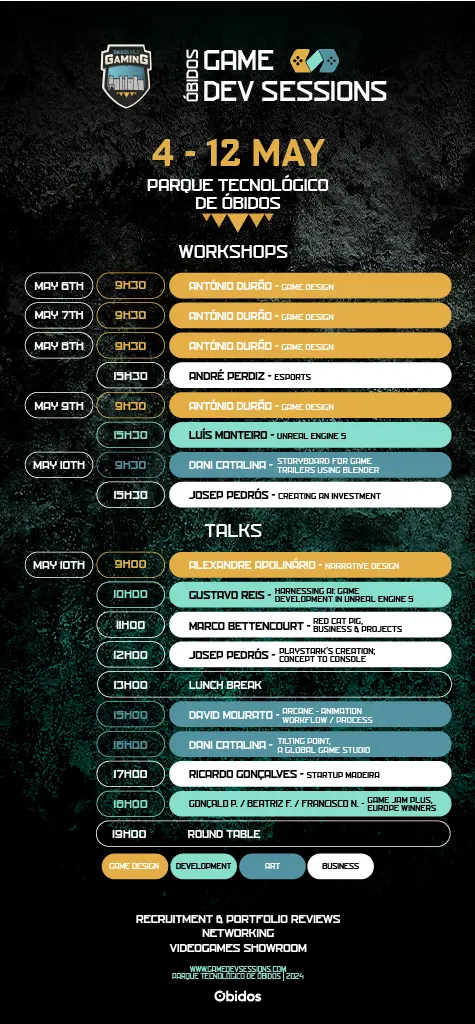
Vai decorrer entre os dias 4 e 12 de maio o evento “Game Dev Sessions” na vila de Óbidos, mais especificamente no espaço do Parque Tecnológico de Óbidos. O cartaz já foi publicado com as sessões que vão decorrer mas ainda não existem grandes detalhes sobre outra informações mais específicas. Mas do cartaz já se podem contar com palestras, workshops e outras sessões com os seguintes oradores: António Durão, André Perdiz, Luís Monteiro, Dani Catalina, Josep Pedrós, Alexandre Apolinário, Gustavo Reis, Marco Bettencourt, David Mourato, entre outros..
+infos(oficial): https://www.obidosvilagaming.pt/
+infos(oficial): https://gamedevsessions.com/
Do Fundão para o mundo..
A Camara Municipal do Fundão, faz parte de um consórcio para o estudo de clusters: “GAME-ER project aims to address this gap by studying and analysing six local and regional clusters, each characterised by varying levels of maturity, creativity and specificities. The objective is to understand the factors contributing to the creation, development and maintenance of new game clusters.” Também a empresa INOVA+ – INNOVATION SERVICES, SA faz parte deste consórcio, no seu portfólio já contam mais de 20 milhões de euros com estas parcerias :)
Ainda assim, o objetivo é chegar a fevereiro de 2027 onde vai ser apresentado um relatório sobre o “provável” cluster que existe em Portugal!! será? .. ” local and regional clusters also are key drivers of innovation, growth and cohesion and GAME-ER will fill the gap around the limited knowledge we have about them..”
+infos(oficial): LINK
7ª Edição das Conversas Gráficas, ISEC
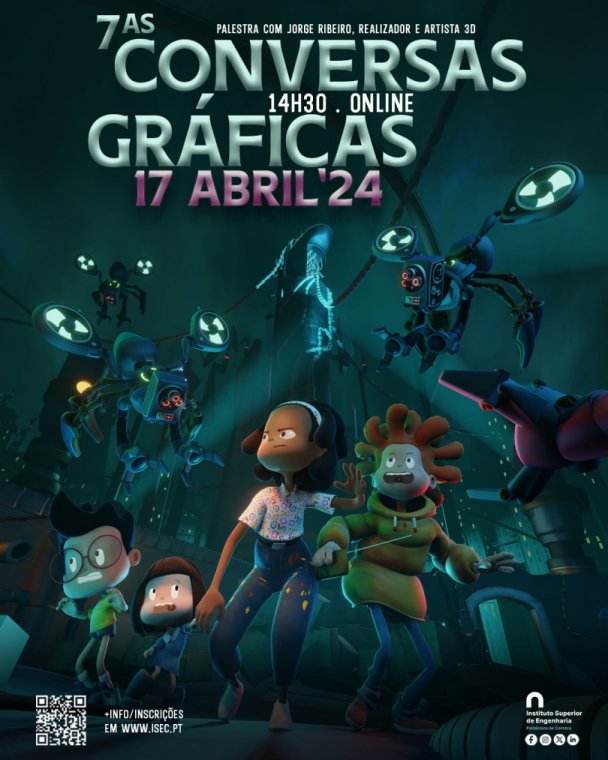
“O Instituto Superior de Engenharia de Coimbra irá realizar a 6ª Edição das Conversas Gráficas, no dia 17 de abril 2023, pelas 14:30, através de videoconferência, com Jorge Ribeiro, realizador e artista 3D.”
+infos(oficial): LINK
Ofertas de trabalho (em abril)
Procura-se um Game Designer (Lisboa/Portugal) pela Overflow Labs, no modo remoto, em que:
“At Overflow Labs, we’re dedicated to crafting unforgettable multiplayer gaming experiences using Unreal Engine technology. As a small, passionate team, our size is our strength, fostering flexibility, creativity, and a close-knit culture where every voice matters. We are looking for a creative and technically skilled Game Designer who is passionate about building engaging gameplay and enhancing player experiences.
Role Overview
The Game Designer at Overflow Labs will be essential in crafting the gameplay elements and mechanics of our games. This role requires a blend of creativity, technical proficiency, and a deep understanding of player psychology to design fun and engaging game systems.
Key Responsibilities
Design and prototype new game mechanics and systems.
Collaborate with artists, programmers, and other team members to ensure the seamless integration of game design with aesthetics and functionality.
Conduct and analyze player tests to refine gameplay and balance game mechanics.
Document design processes and communicate concepts clearly to the rest of the team.
Ideal Candidate
3+ years of experience in game design, with a strong portfolio demonstrating a range of projects.
Proficient with game development tools, especially Unreal Engine.
Strong understanding of game mechanics and player engagement strategies.
Excellent problem-solving skills and the ability to adapt designs based on feedback.
Strong communication and teamwork skills, capable of working effectively in a remote setting.
Passionate about games and an avid gamer with insights into what makes games successful.”
+infos(oficial): LINK
Procura-se um Senior Game Designer (Oeiras/Portugal) pela MiniClip, no modo híbrido, em que:
“As Game Designer you will be creating fun, exciting mobile game experiences with creative input from the initial pitch to the global launch. You will work closely with our design and mobile games teams . You will report to our Lead Game Designer.
What will you be doing at Miniclip?
Design and craft mission gameplay experiences and game features that deliver strong player engagement, retention, and monetization.
Take ownership of mission gameplay design and implementation, collaborating cross-discipline to create new and exciting scenarios and moment-to-moment gameplay.
Participate as a key member of the product team across the product life-cycle, working on games in production, and live titles, owning and creating high-impact gameplay content updates for our existing portfolio of games.
Plan and execute mission designs within Unity using our proprietary tools and editors, from inception to finished product.
Review and iterate gameplay designs and mission implementation both during production and post-release, incorporating feedback from key stakeholders and directing mission changes to balance game content based on analytics data.
Help identify and deconstruct new markets and opportunities, expanding the portfolio of the company and staying at the cutting edge of the mobile gaming industry.
What are we looking for?
4+ years’ experience of gameplay and systems design, monetisation and live ops on freemium mobile games. .
An excellent knowledge and understanding of gameplay design, complex game economy systems with multiple currencies, and progression systems.
Experience across the product life-cycle, from prototyping, through production, to updating a live free-to-play game.
Strong knowledge of the mobile & social game space, with an exceptional understanding of current design techniques to deliver excellent engagement, retention, and monetisation.
Understanding of and experience with reviewing game analytics, developing insights based on data to make better informed design decisions.
Strong grasp of mobile user-experience design, and ability to consider & empathise with many different types of players.
Creative problem solver, with proven ability to create compelling gameplay.
Relentlessly self-critical always sees the pros and cons of each approach, and works tirelessly to improve design solutions. Prolific with high-quality, well-thought-through proposals. ”
+infos(oficial): LINK
Procura-se um Game Designer (Almada/Portugal) pela Kwalee, no modo híbrido, em que:
“As Game Designer you will be creating fun, exciting mobile game experiences with creative input from the initial pitch to the global launch. You will work closely with our design and mobile games teams . You will report to our Lead Game Designer.
Responsibilities
Working as part of the design team, taking responsibility for multiple mobile game projects, from an initial pitch all the way to global launch.
Keeping track of market trends and coming up with game ideas that will be well received by the ever-changing hybrid casual gaming audience.
Designing compelling game mechanics using modern mobile design principles. Creating, balancing and tuning game mechanics, game difficulty and UI flow.
Creating levels and additional content using Unity, for new and existing games.
Evolving and adapting game designs based on play testing, feedback and live metrics.
Driving long term player engagement by understanding mobile players needs and motivations.
Requirements
A minimum of 2 years experience in a game design role with at least one published relevant game.
Strong written and verbal communication skills.
Ability to work creatively in a demanding team environment.
Absolute passion for playing and making video games, especially mobile games.
Strong creative ideas and imagination, able to entertain players with challenges, humour, surprises and fun.
Positive attitude, self driven, able to work alone or as part of a team.
Knowledge of mobile free-to-play game monetisation and advertising techniques.
Based in one of our office hubs, following our hybrid model with 3 days per week on-site. ”
+infos(oficial): LINK
GDevelop
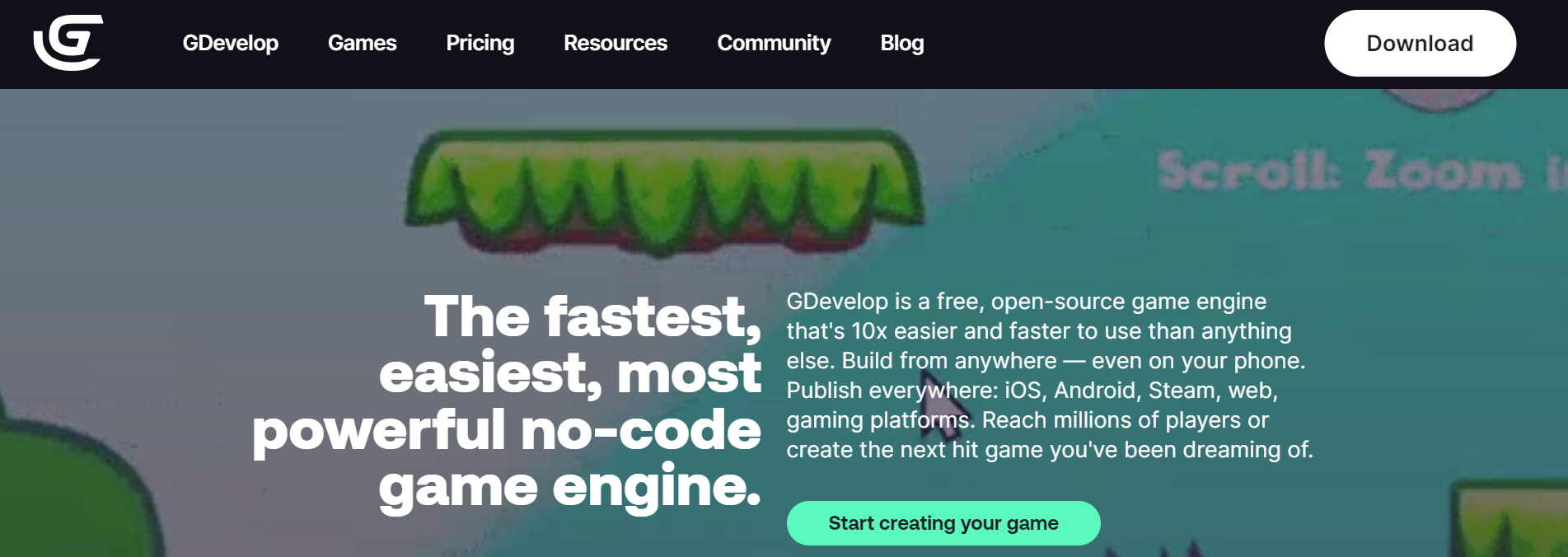
Mais um motor para desenvolver videojogos? a experimentar..
+infos(oficial): https://gdevelop.io/
às vezes é assim…
“Assim como nos jogos, onde as “side quests” podem conduzir a recompensas valiosas e melhorias para os personagens, as nossas próprias missões paralelas na vida frequentemente levam a descobertas surpreendentes. Uma “side quest” como speaker pode surgir do desenvolvimento de habilidades de stand-up comedy, e um projeto paralelo de sketch comedy pode abrir portas para novas oportunidades criativas.
Ao abraçarmos as “side quests” da vida, expandimos os nossos horizontes, encontramos novas paixões e desenvolvemos habilidades inesperadas. As “side quests”, muitas vezes consideradas atividades secundárias, têm o poder de se transformar na missão principal, redefinindo a nossa vida e proporcionando um sentido renovado de propósito.
Portanto, da próxima vez que te deparares com uma oportunidade fora do caminho principal, seja na forma de um hobby, projeto paralelo ou encontro casual, talvez a devas encarar como uma valiosa “side quest”. Pois, tal como nos jogos, são estas missões paralelas que frequentemente revelam as nuances mais ricas da experiência humana, transformando o ordinário em extraordinário e proporcionando um sentido mais profundo à nossa vida.”
//–
“Just like in games, where side quests can lead to valuable rewards and improvements for the characters, our own side quests in life often lead to surprising discoveries. A side quest as a speaker can arise from developing stand-up comedy skills, and a sketch comedy side project can open doors to new creative opportunities.
By embracing life’s side quests, we expand our horizons, find new passions and develop unexpected skills. Side quests, often considered secondary activities, have the power to become the main mission, redefining our lives and providing a renewed sense of purpose.
So the next time you come across an opportunity off the beaten track, be it in the form of a hobby, side project or chance encounter, perhaps you should see it as a valuable side quest. Because, just like in games, it’s these side quests that often reveal the richest nuances of the human experience, transforming the ordinary into the extraordinary and providing deeper meaning to our lives.”
por PTochas
Humble Software Bundle (campanha)
Uma campanha de assets para ajudar no desenvolvimento de videojogos, com o titulo “The best of Synty #2 Remix – Game Dev Assets“ em que:
“Bring your game to life with this massive bundle of distinctive, stylized low-poly 3D assets from Synty! You’ll get assets usable in Unity and Unreal to fit a wide spectrum of settings—everything from Ancient Rome and various flavors of the modern day, to far-future sci-fi! Included are dozens upon dozens of characters, buildings, interior and environmental props, special effects, and more. Craft grand Greek-inspired temples, neon-drenched urban nightclubs, and sleek, deadly starships, and people them memorable characters appropriate to their settings.
e da lista surgem:
POLYGON – Ancient Empire
POLYGON – Sci-Fi Space Pack
POLYGON – Farm Pack
POLYGON – Office Pack
POLYGON – City Zombies Pack
POLYGON – Town Pack
POLYGON MINI – Fantasy Characters Pack
POLYGON – City Characters Pack
POLYGON – Fantasy Characters Pack
POLYGON – Icons Pack
POLYGON – Nightclubs
POLYGON MINI – City Characters Pack
Sizzler – First time on Humble
POLYGON – Fantasy Rivals Pack
POLYGON MINI – Fantasy Pack
POLYGON – Prototype Pack
POLYGON MINI – City Pack
POLYGON – Spy Kit
POLYGON – Explorer Kit
POLYGON – Snow Kit
”
+infos(oficial): LINK

Uma campanha de assets para ajudar no desenvolvimento de videojogos com o Unreal, com o titulo “The Unreal Environment Mega Bundle“ em que:
“Unreal developers, this bundle will give you everything you need to craft game environments that’ll enthrall and immerse your players! Included are 15 packs of full models, meshes, visual effects, and more, modular and ready to drop into your Unreal Engine project. You’ll get assets suitable for all kinds of genres, enabling you to create stunning fantasy worlds, blighted post apocalyptic settings, lush natural environments, and much more.
e da lista surgem:
Modular Medieval Village
Stylized Nature
Modular Destroyed Buildings
Post Apocalyptic Town
Modular Dungeon – Dungeon Building Kit
Abandoned Factory
Dragon Temple
Modular Medieval town
Modular Desert Town
Modular Medieval Houses
Modular Wooden Buildings
Monster Sounds
Rain & Wind Sounds (Loopable)
Game Music Essentials (Loopable)
Horror Ambient Loops (Loopable)
Medieval Weapons Bundle
Stylized Medieval Village
Modular Medieval Buildings
Modular Castle Kit
”
+infos(oficial): LINK
Uma campanha de assets para ajudar no desenvolvimento de videojogos “GameMasters Toolkit Assets & Tutorials Bundle“ em que:
“Get the skills and building blocks you need to create stunning game assets with this bundle from Leartes Studios. You’ll get a host of asset packs ready to plug into your Unity and Unreal projects, ranging from interior and exterior environments, to props and icons and more. Also included are a selection of tutorials produced by Leartes and their partners, created to skill you up on essential tools and techniques like Lumen, Unreal’s global illumination and reflections system.
e da lista surgem:
Sensei Lumen Tutorial
Abandoned Industrial Environment
Sensei Ligtmass Tutorial
Historical Museum
Modern City Environment Megapack
Engine Unreal Sensei 03 Path Tracing
How to Make Awesome Cinematics
Make AAA Game Vehicles
Environment Design
Blueprints Game Developer Masterclass
3D Game Development With GoDot Game Engine
Game Design & Development : 20+ 2D & 3D Projects
Android Game Development : Build 10 2D & 3D Games
Cyberpunk Handguns
Cyberpunk Shotguns
Sedan Car Vehicles Set Driveable / Animated / Realistic (Set of 4)
SFX Post Apo Diner
VFX Water Visual Effects
Medieval Tavern
Modern Office Environment
Coffee Shop Environment
Abandoned Hut in Tropical Island
Stylized Indian City ( Stylized , City , Stylised )
Stylized Wizard Room
Ultimate Level Art Tool
Modular Stylized Christmas Market
Stylized Paris Street
Bowling Alley
Stylized Cyberpunk Arcade Environment
75% Discount Code Cosmos by Leartes
Sensei Lighting fundemantals
Create Zombie Survivor FPS Game
Maya & Unity 3D – Modeling Lowpoly Tree for Mobile Games
Create Advanced Water Shader
Mastering GoDot Game Engine
Create Your First RPG And FPS Multiplayer Game In Unity
Game Development: Create 2D And 3D Games With C#
Modeling Tutorial 1 (Maya + ZBrush + Substance Painter Game Ready Prop Tutorial )
Home Interior Pack
FPS 4K Western Guns – VOL.1
Sci-Fi / Futuristic Corridor
Victorian Decayed Alley Environment
Material Assignment Tool (Tool)
Florence Cathedral Pack ( Cathedral Environment / Cathedral Props )
500+ Fantasy Icons (Unity)
Master Unity By Building 6 Fully Featured Games From Scratch
Create Auto Landscape Material
Level Tutorial 1 (Time lapse tutorial)
Fantasy Interior Environment
Object Distribution Tool
”
+infos(oficial): LINK

Uma campanha de livros para ajudar no desenvolvimento de videojogos para usar em diferentes game engines e outros softwares “Game Dev Toolbox Master Unity, Unreal Engine, Blender and More“ em que:
“Looking to become a game developer? This bundle of video courses will serve as your foundation. Learn to create stunning in-game assets with Blender, ranging from stylized character models to detailed environments—and acquire the skills required to bring those creations to life in Unreal Engine. Master programming in C#, the versatile programming language that will help you work in Unity, create apps and games for Android, and much more.
e da lista surgem:
Unity C# Scripting – Complete C# for Unity Game Development
The Complete Android Oreo Developer Course – Build 23 Apps
Unity Android – Build Eight Mobile Games with Unity and C#
Unity Game Projects – 20+ Mini Projects in Unity and C#
C# and Unity by Example – 20+ Mini Game Development Projects
Unreal Engine 5 – Endless Runner
Unreal Engine – Ultimate Survival Horror Course
Unreal Engine 5 – Sci-Fi Environment Design
Google Apps Script Complete Course – Beginner to Advanced
Unreal Engine 5 – Environment Design
Unreal Engine 5 – Make AAA Game Vehicles
Blender to Unreal Engine 5 – 3D Props – Medieval Windmill
Substance Painter to Unreal Engine 5 Masterclass
Unity Android: Build 3D Endless Runner Hyper Casual Game
Creating Stunning Environments in Unreal Engine 5 – A Game Artist Bootcamp
Building Medieval Worlds – Unreal Engine 5 Modular Kitbash
Mastering the Art of Isometric Room Design in Blender 3
Master ARCore 1.3 Unity SDK – Build 6 Augmented Reality Apps
Unity Android Game Development – Build Seven 2D and 3D Games
Blender 4 Creator Course Stylized 3D Models
The Blender 4 Ultimate Guide
Blender Lighting & Compositing for Beginners
Blender 3 to Unreal Engine 5 – Dungeon Modular Kitbash
Blender to Unreal Engine – Become a Dungeon Prop Artist
Blender 4 Geometry Nodes for Beginners
Blender to Unreal Engine 5 The Complete Beginners Guide
Blender Beginner’s Bootcamp
Unreal Engine 5 Beginner’s Guide to Building a 3D Environment
Blender to Unreal Engine – 3D Plants and Vegetation
”
+infos(oficial): LINK

Uma campanha de assets para o desenvolvimento de videojogos para usar com o Unity “Prototype to Publish in Unity“ em que:
“Get your game idea out of your head and into the world with this Unity bundle, full of assets and tools to help you hit the ground running with prototyping! Whether you’re looking for 3D models, tools to create your own sprites, or packages full of readymade effects, you’ll be covered. You’ll also get access to a host of toolkits to help you painlessly implement critical game features, everything from quest and inventory systems, to grid and hex-based maps.
e da lista surgem:
EXPLORER – Stone Age
Runtime Asset Database
Sounds Good – Easy & Optimized Audio Manager
Lumen: Stylized Light FX
AR VR Mixed Reality
Character Auras
Low Poly Cats
Grid Controller
ProtoSprite: Pixel Art Painter
3D Wizard
Hexasphere Grid System
Pure Nature 2 : Mountains
Liquid Volume 2
InventoryPlus: Customizable Inventory System
Components for HORROR FPS KIT
Flock Box DOTS
Pixel Art Platformer – Dungeon
M Farm RPG Assets Pack
Quests system for Unity
POLYGON Vikings – Low Poly 3D Art by Synty
”
+infos(oficial): LINK
Livros em destaque em março’2024
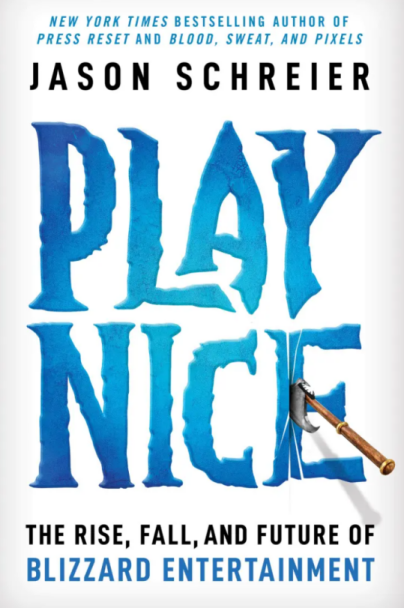
Play Nice, The Rise, Fall, and Future Of Blizzard Entertainment por Jason Schreier
”
New York Times bestselling author and the gaming industry’s preeminent investigative journalist Jason Schreier examines three decades of ups and downs at Blizzard Entertainment leading up to a hostile corporate takeover and a sexual misconduct scandal that put the legendary developer in a world of (Warcraft) trouble.
For video game fans, the name Blizzard Entertainment was once synonymous with perfection. The renowned company behind classics like Diablo and World of Warcraft was known to celebrate the joy of gaming over all else. What was once two UCLA students’ simple mission — to make games they wanted to play — launched an empire with thousands of employees, millions of fans, and billions of dollars.
But when Blizzard cancelled a buzzy project in 2013, it gave Bobby Kotick, the infamous CEO of corporate parent Activision, the excuse he needed to start cracking down on Blizzard’s proud autonomy. Led by executives from McKinsey and Procter & Gamble, Activision began invading Blizzard from the inside. Glitchy products, PR disasters, and mass layoffs followed, marring the company’s once pristine image. Then, in 2021, a staggering sexual misconduct and discrimination lawsuit against the company triggered a widespread reckoning and a shocking $69 billion acquisition.
Based on firsthand interviews with more than 300 current and former employees, PLAY NICE chronicles the creativity, frustration, beauty, and betrayal across the epic 33-year saga of Blizzard Entertainment. From previously unrevealed stories of Blizzard’s early culture, including fist fights and a hotel ban, to the full story of Titan, Blizzard’s most high-profile canceled project, and the behind-the-scenes saga of how Blizzard executives battled their Activision overlords tooth and nail, this book explores the delight and despair of what it really means to “bleed Blizzard blue.” Full of colorful personalities and dramatic twists, PLAY NICE is The Social Network for the video game industry.
”
Um livro a ler, deve ter algumas histórias bem interessantes.
+infos(amazon): LINK
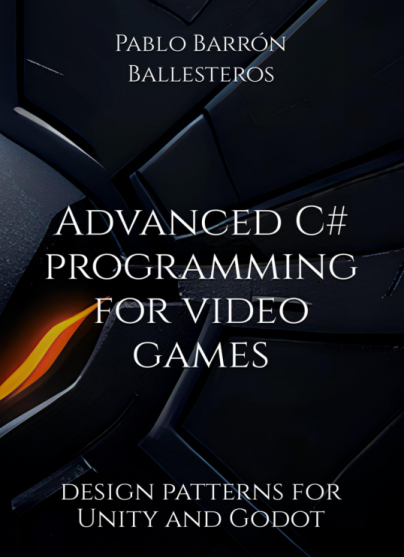
Advanced C# programming for video games: design patterns for Unity and Godot por Pablo Barrón Ballesteros
“Level up your video game programming!
An advanced level of programming is essential to successfully undertake a video game project, whether in a professional studio or as an indie developer. This book will teach you the secrets of design patterns for Object-Oriented Programming (OOP). Design patterns are an essential tool that tell apart the hobbyist who struggles to complete a video game without coding errors, from the professional capable of undertaking a complex video game project. In this book, each design pattern is thoroughly explained using C# code suitable for Unity and Godot, with examples drawn from real video game programming. Learn how to structure an inventory, a quest subsystem, a crafting queue, items with various uses, decision systems for your NPCs, visual novels, and more. Understanding design patterns in programming will empower you to program anything you desire.
“Advanced C# Programming for Video Games” begins with an introduction to OOP in C# and its basic concepts, covering from classes and encapsulation to method overloading, polymorphism, interfaces, and abstract classes. It then progresses to analyzing creational, structural, and behavioral patterns. For every pattern, a functional C# code example is provided. For instance, the Prototype pattern will guide you in dealing with a collectible card video game and MOBA champions, the Decorator will demonstrate how to create roguelike enemies and weapons, the Flyweight will unveil the secrets of a “Bullet Hell” game and how to manage 2D tiles in expansive game worlds, the Memento will teach you techniques to create savegames, and the Template Method will address AI in strategy games or special occupations for your characters.
Don’t miss this extensive work by a professional programmer. Learn at last how to develop your video game like a professional.”
+infos(amazon): LINK
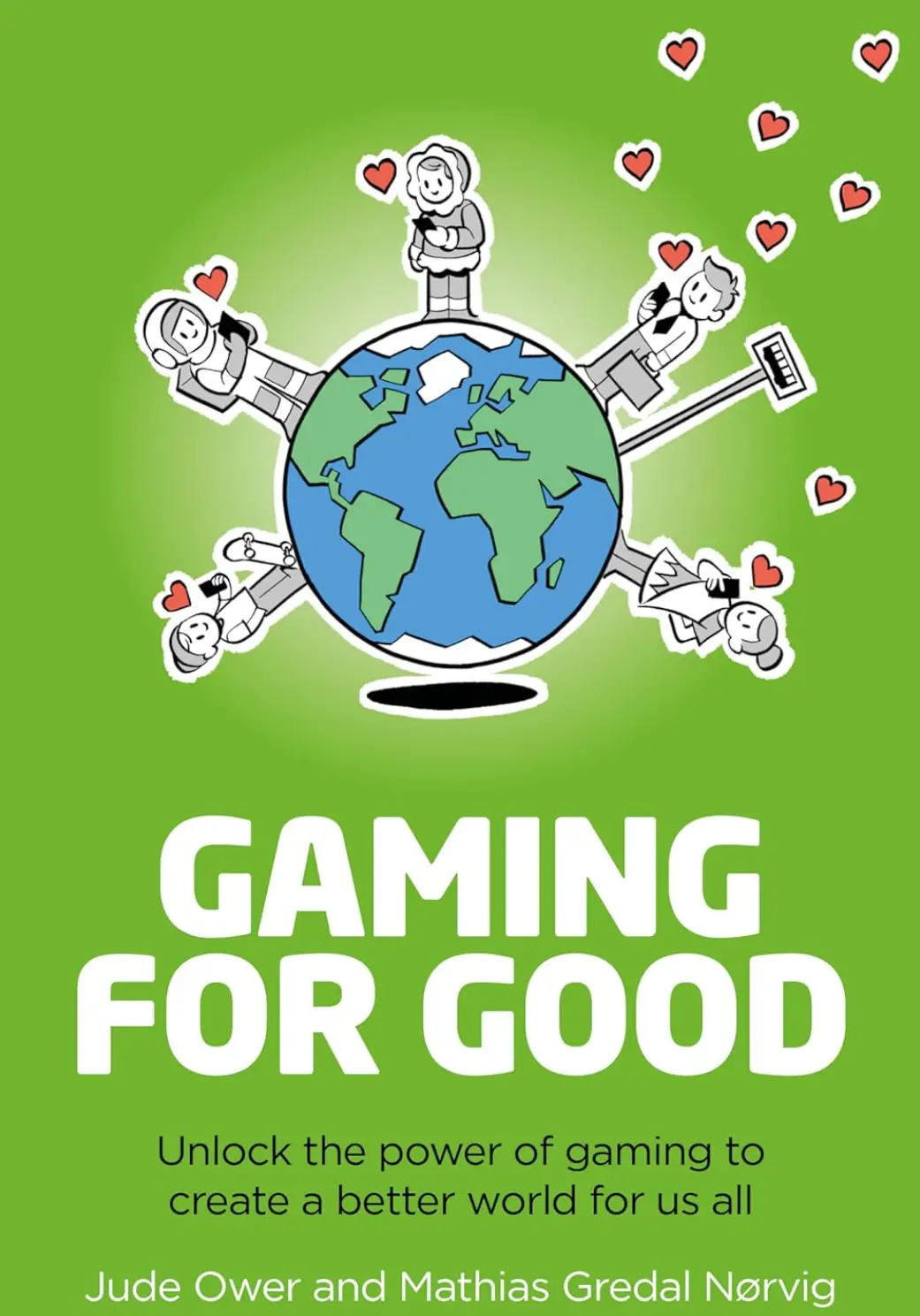
Gaming for Good: Unlocking the Power of Gaming to Create a Better World for Us All, por Jude Ower a Mathias Gredal Nørvig
“Over 3 billion people play games globally. How can we turn his immense power into a force for good?
Games are already influencing player behaviour and decision-making. This book dispels the often negative perception of gamers and the games they play every day and shows how to harness the medium’s potential. Whether you’re a gamer, in the industry, not in the industry but interested in games or a parent worried about the impact of games on your kids, read this book to:
Understand the industry and gaming culture and why it lends itself perfectly to tackling global challenges
Discover how games can be a force for good through real-world examples, underpinned by interviews with leading executives in the industry
Be inspired to make a positive impact using games
Recognise that ‘doing good’ corresponds with ‘doing well’ and can drive wider beneficial outcomes such as deeper engagement”
Gostava de ter acesso a este livro para ler mais um pouco sobre o desenvolvimento de videojogos de “for good”.
+infos(amazon): LINK
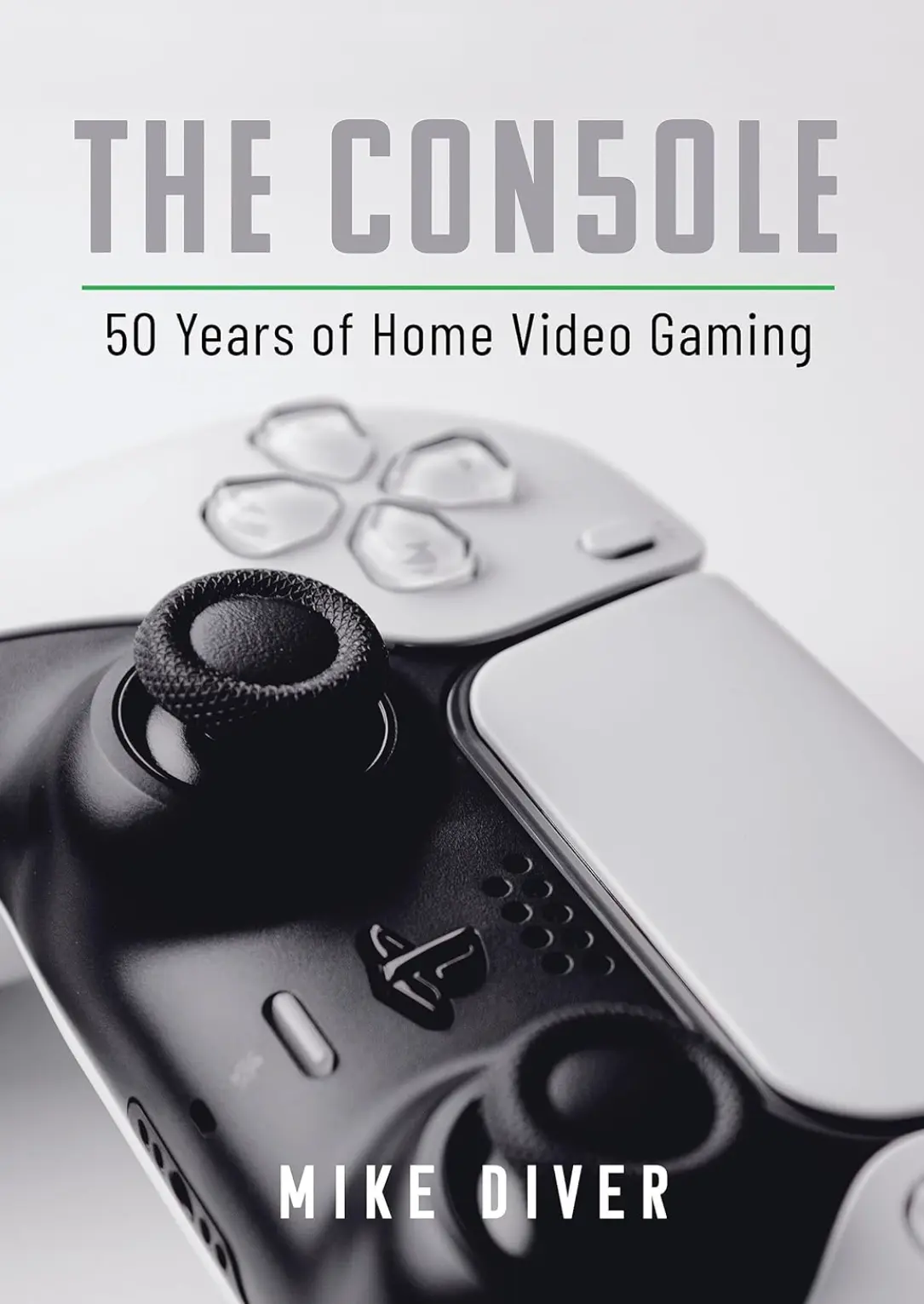
The Console: 50 Years of Home Video Gaming por Mike Diver
“THE CON50LE is a comprehensive yet conversational account of 50 years of home video gaming history, leaving no rarely sighted system unturned and providing a chronological account of the evolution of the biggest entertainment medium in the world. From the earliest consoles of the 1970s to the cutting-edge machines of the here and now, a line is drawn from one man’s eureka moment to the multi-billion-dollar global industry of today. All the well-known names and massive-selling consoles are here: the Nintendo Entertainment System, the SEGA Mega Drive, the Atari 2600, the Xbox 360, the PlayStation 2. But there’s plenty of room for hardware that many a gamer won’t have heard of before, from Japan-only releases and home computer conversions to ill-advised experiments with VHS and all manner of micro-console magic. Learn about the creators and their inspirations, the games that made the biggest consoles’ eternal reputations, and the failures and flops along the way. Even the consoles that came and went without notable commercial success left a mark, an imprint, on this compelling history – and THE CON50LE unravels it, explains it, one fascinating machine at a time.”
Gostava de ter acesso a estes livro, parece ser um livro histórico acerca do mundo das consolas domésticas.
+infos(amazon): LINK
Workshop de Godot (no Porto)
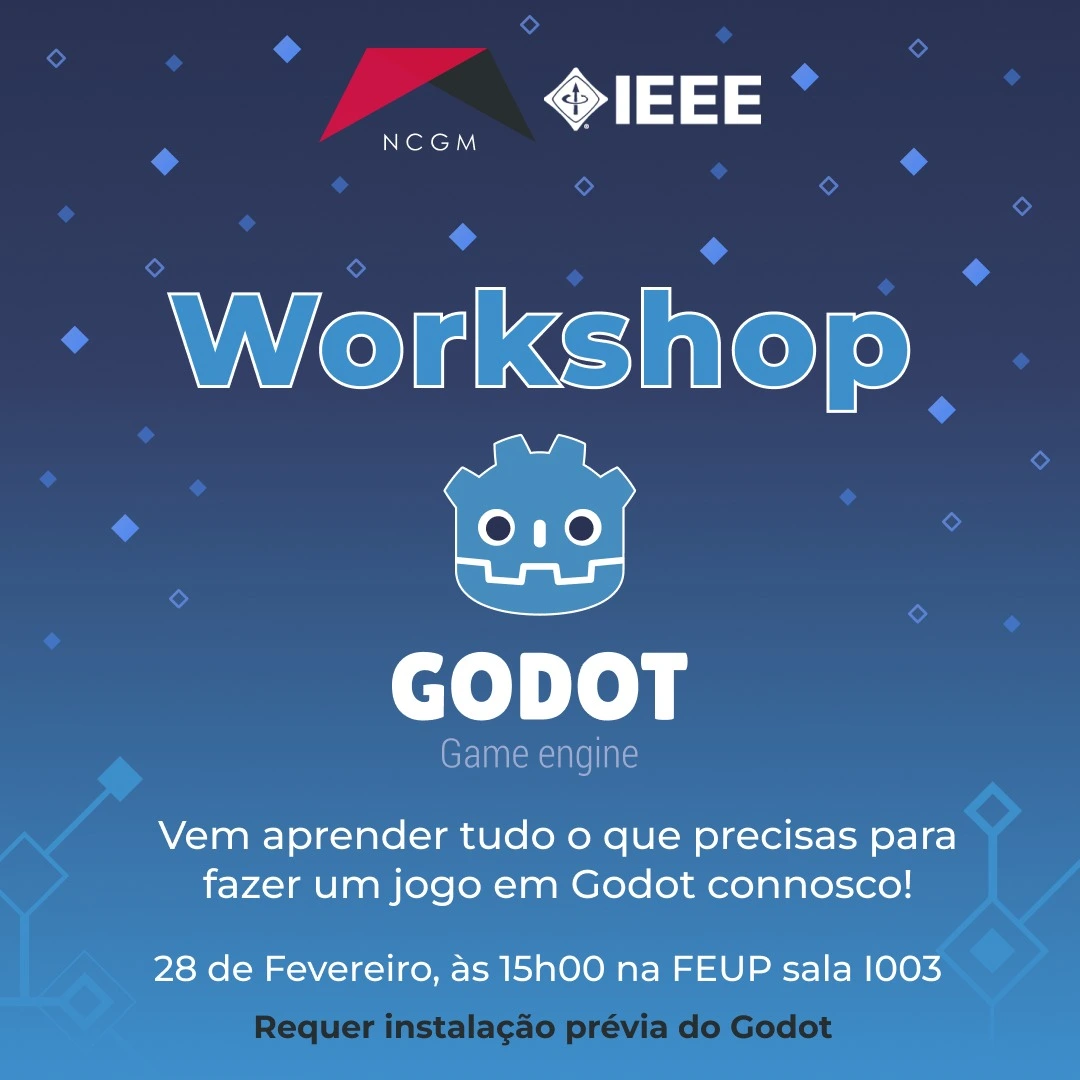
“O NCGM convida-te a participar no workshop a realizar-se dia 28 de Fevereiro às 15h na sala … na FEUP.
Neste workshop, direcionado para iniciantes em Godot, iremos criar em conjunto um jogo! Pelo que irás explorar todo o processo para a criação de um pequeno jogo desde programação, VFX e UI.
O objetivo deste workshop é ganhares bases para te orientares sozinho com o software.
Inscrições abertas até dia 27 de Fevereiro.”
+infos(oficial): https://linktr.ee/ncgm
GameMaker grátis até ser um projeto comercial

Tenho uma relação estranha com o motor GameMaker, o meu primeiro contacto foi quando no site humblebundle.com surgiu um pack em que este motor ficava com uma licença bem simpática. Contudo e após a campanha no humblebundle terminar sai uma nova versão do GameMaker, com uma interface e mecanismos novos, o que implicou que quem como eu comprou a licença anterior foi forçado a comprar uma nova para poder usar a nova versão..
Ainda assim, o GameMaker foi comprado pela malta do Browser Opera e uma das decisões foi mesmo a a de libertar este software para qualquer pessoa usar. O limite é o produto final não ser comercial nem ter como destino as consolas. E para quem quer continuar a usar basta pagar uma única vez 99 dólares.
+infos(oficial): LINK
Uma palestra de Casey O’Donnell
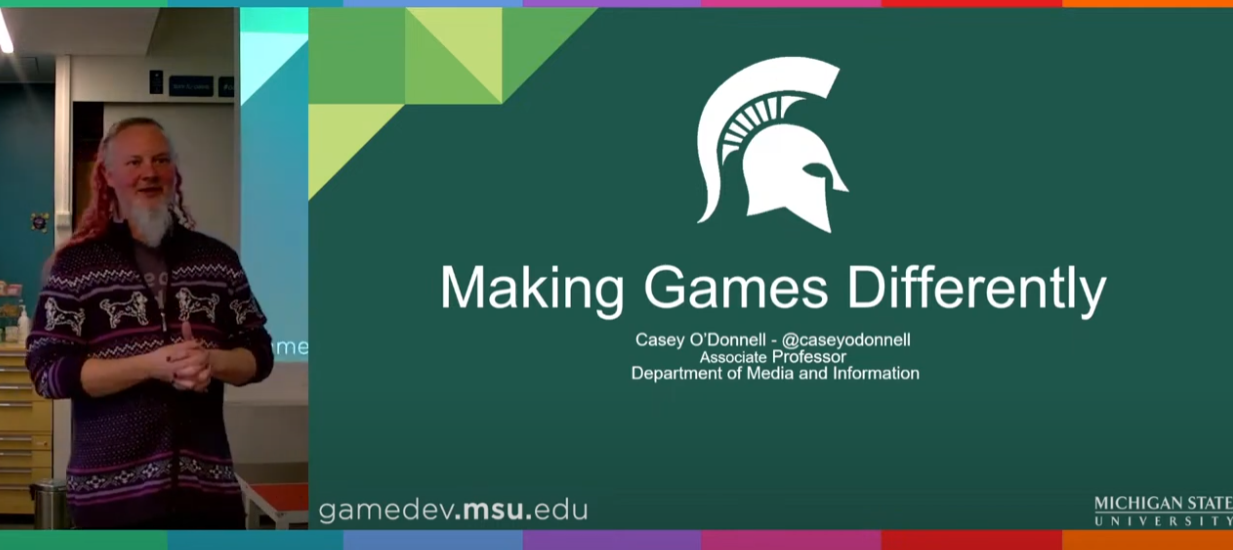
Uma palestra interessante sobre Making Games Differently
+infos(video): LINK
Aprender Godot..
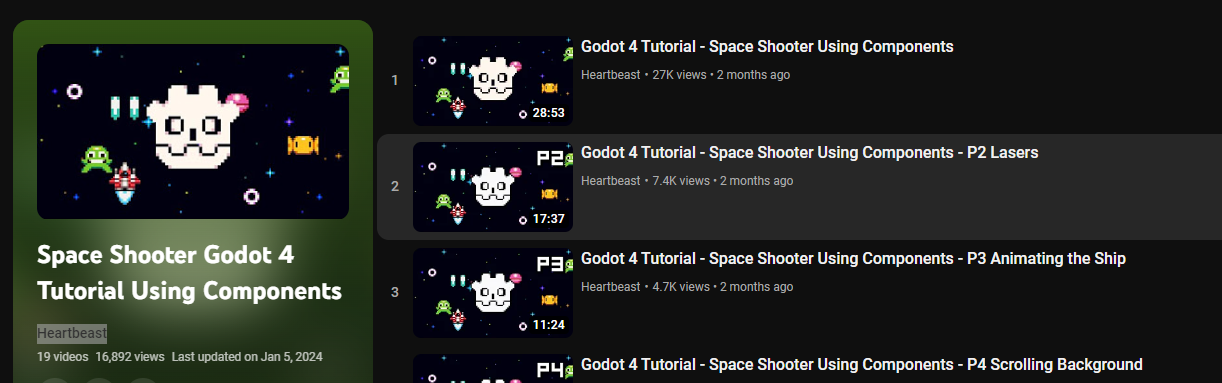
Para quem, como eu, que anda a adiar para aprender a usar Godot, fica aqui um video tutorial pelo Heartbeast, em que explica o desenvolvimento de um Space Shooter nesta plataforma.
+infos(oficial): LINK
E também encontrei este web site que é um repositório de ferramentas para trabalhar com o Godot e existe também uma comunidade :)
+infos(oficial): https://chickensoft.games/
O ano de 2023 em números, diz a GamesIndustry.biz
O site GamesIndustry.biz publicou recentemente os seus números relativos ao ano de 2023 e produziu um infográfico todo catita para mostrar esses números:

o que se destaca aqui é aumento de receitas relacionado com a venda de videojogos, que jogos como Call of Duty, Diablo, Mortal Kombat, Madden NFL, continuam a ser best sellers nos Estados Unidos, e que até o Brazil aparece nos top5 dos países que mais downloads de videojogos fazem. Também é dada relevância ao aparecimento dos videojogos nas redes sociais.
+infos(oficial): LINK
Livros interessantes… (e que gostava de ter acesso)
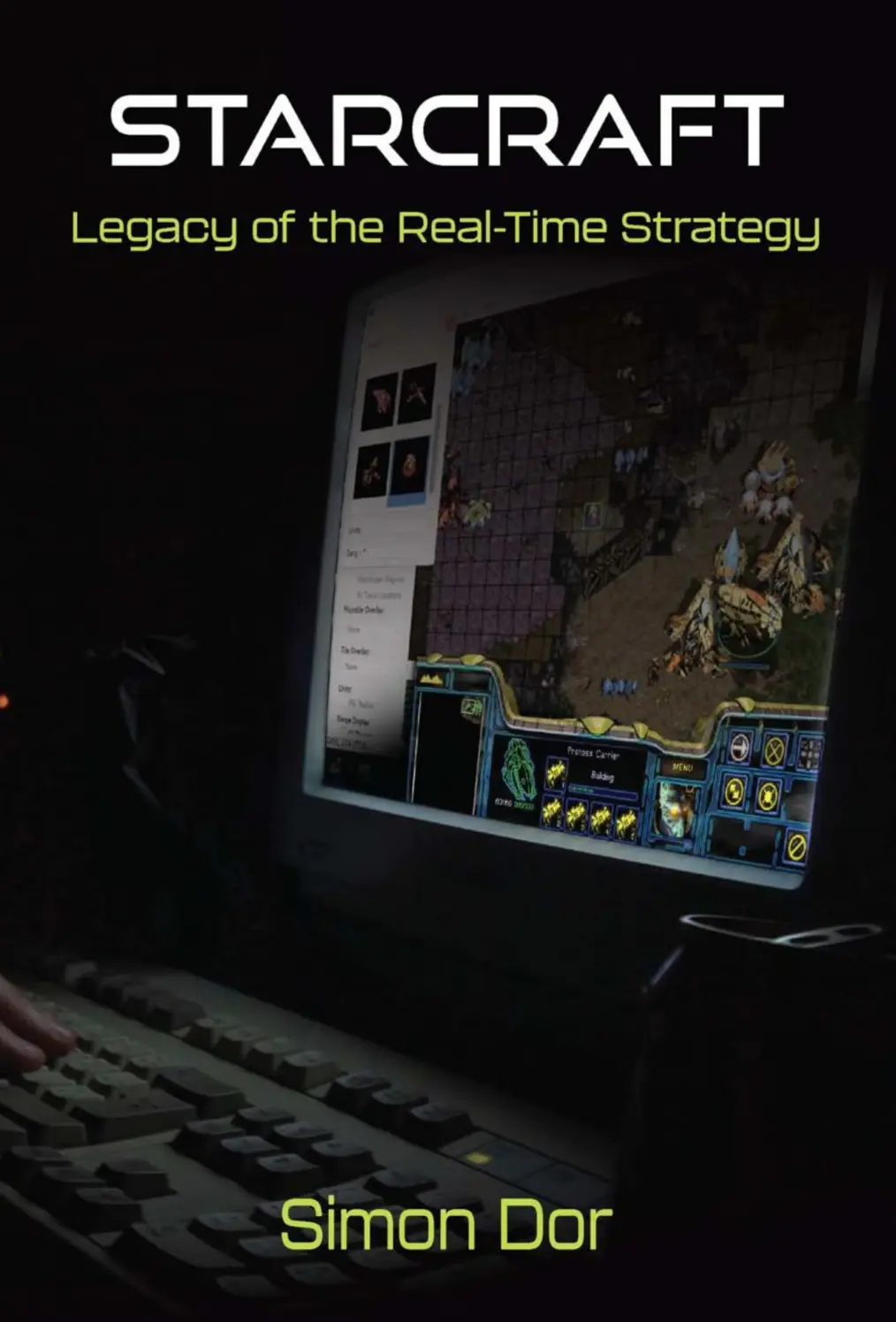
Já é possivel aceder gratuitamente (18 março de 2004) a este livro intitulado “StarCraft: Legacy of the Real-Time Strategy” de Simon Dor. O conteúdo passa pelas secções:
1. Decoding and Foreseeing
2. A Distinct Purity of Form
3. No rush
4. Path Of ascension
5. A distinct Purity of Essence
E ainda como texto de apresentação surge:
“StarCraft (Blizzard Entertainment, 1998) is a real-time strategy video game, placing the player in command of three extraterrestrial races fighting against each other for strategic control of resources, terrain, and power. Simon Dor examines the game’s unanticipated effect by delving into the history of the game and the two core competencies it encouraged: decoding and foreseeing. Although StarCraft was not designed as an e-sport, its role in developing foreseeing skills helped give rise to one of the earliest e-sport communities in South Korea.
Apart from the game’s clear landmark status, StarCraft offers a unique insight into changes in gaming culture and, more broadly, the marketability and profit of previously niche areas of interest. The book places StarCraft in the history of real-time strategy games in the 1990s—Dune II, Command & Conquer, Age of Empires—in terms of visual style, narrative tropes, and control. It shows how design decisions, technological infrastructures, and a strong contribution from its gaming community through Battle.net and its campaign editor were necessary conditions for the flexibility it needed to grow its success. In exploring the fanatic clusters of competitive players who formed the first tournaments and professionalized gaming, StarCraft shows that the game was key to the transition towards foreseeing play and essential to competitive gaming and e-sports.”
+infos(oficial): LINK
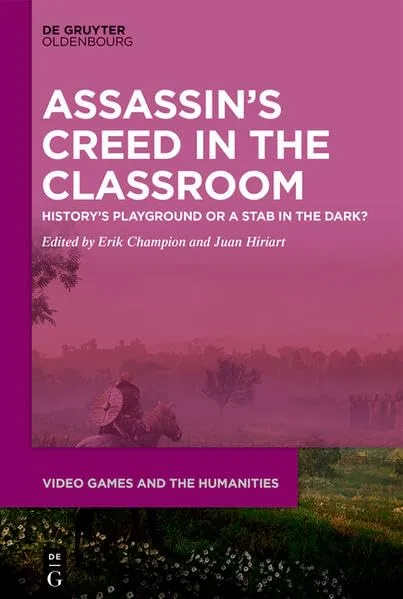
Também encontrei este livro, “Assassin’s Creed in the Classroom History’s Playground or a Stab in the Dark?” dos editores Erik Champion e Juan Francisco Hiriart Vera. Do texto de apresentação surge:
“The open world role-playing Assassin’s Creed video game series is one of the most successful series of all time, praised for its in-depth use of historical characters and events, compelling graphics, and addictive gameplay. Assassin’s Creed games offer up the possibility of exploring history, mythology, and heritage immersively, graphically, and imaginatively. This collection of essays by architects archaeologists and historiansexplores the learning opportunities of playing, modifying, and extending the games in the classroom, on location, in the architectural studio, and in a museum.”
O livro tem também os seguintes contributos:
Introduction: History’s Playground or a Stab in the Dark?
Chapter 1 Historical Video Games and Teaching Practices
Chapter 2 Discovery Tour Curriculum Guides to Improve Teachers’ Adoption of Serious Gaming
Chapter 3 Christian Vikings Storming Templar Castles: Anachronism as a Teaching Tool
Chapter 4 Ludoforming the Past: Mediation of Play and Mediation of History through Videogame Design
Chapter 5 Exploring History through Depictions of Historical Characters in Assassin’s Creed Odyssey
Chapter 6 Empathy and Historical Learning in Assassin’s Creed Valhalla Discovery Tour
Chapter 7 The Discovery Tour as a Mediated Tool for Teaching and Learning History
Chapter 8 Discovering the Past as a Virtual Foreign Country: Assassin’s Creed as Historical Tourism
Chapter 9 Classical Creations in a Modern Medium: Using Story Creator Mode in a University Assignment
Chapter 10 Assassin’s Creed @ The Carlos: Merging Games and Gallery in the Museum
Chapter 11 From the Sketchbook to Assassin’s Creed Valhalla: An Experiment in Architectural Education
Chapter 12 Assassin’s Creed As Immersive and Interactive Architectural History
+infos(oficial): LINK
Ofertas de trabalho (em fevereiro)
Procura-se um Lighting Artist (hibrido ou presencial, em Lisboa), em que:
”
We are looking for you to have:
Minimum 3 years coof mmercial production experience in a lighting or technical art role
Strong understanding of latest games art fundamentals of real-time lighting, physically based rendering, materials, and post-processing
Portfolio or demo reel that demonstrates a keen eye for detail, knowledge of color theory and the ability to use light, shadow and color to create a variety of tones and moods
Working knowledge of Photoshop and 3ds Max or equivalent
Great communication, ability to follow creative direction, self-driven organization, and time management skills
Bachelor/Undergraduate degree or equivalent
In addition, ideally, you might also have:
Extensive UE5 knowledge, with project examples
Keen interest in playing games and game development beyond art
Prior experience with helping mentor your colleagues
”
+infos(oficial): https://www.funcom.com/funcom-zpx/
Procura-se um Lead Games Designer (hibrido ou presencial, em Lisboa), em que:
”
We are looking for you to have:
A bachelor’s degree
5+ years of experience in the game industry working in a game design capacity
2+ years of experience leading/managing a team
Shipped titles in a professional capacity
Extensive understanding of design processes including NPC design, feature design, level design, content design, as well as experience implementing features and content
Passion for leadership and mentoring
Clear, effective communication skills across teams and cultures
Motivation and drive to collaborate and advance positive change in a studio environment
The ability to work diligently while thinking critically and resolving complex issues
In addition, ideally, you might also have:
Experience working on survival or MMO games
Worked on games in a live environment
Enjoys playing survival games
Familiarity with Dune and the Dune IP
”
+infos(oficial): https://www.funcom.com/funcom-zpx/
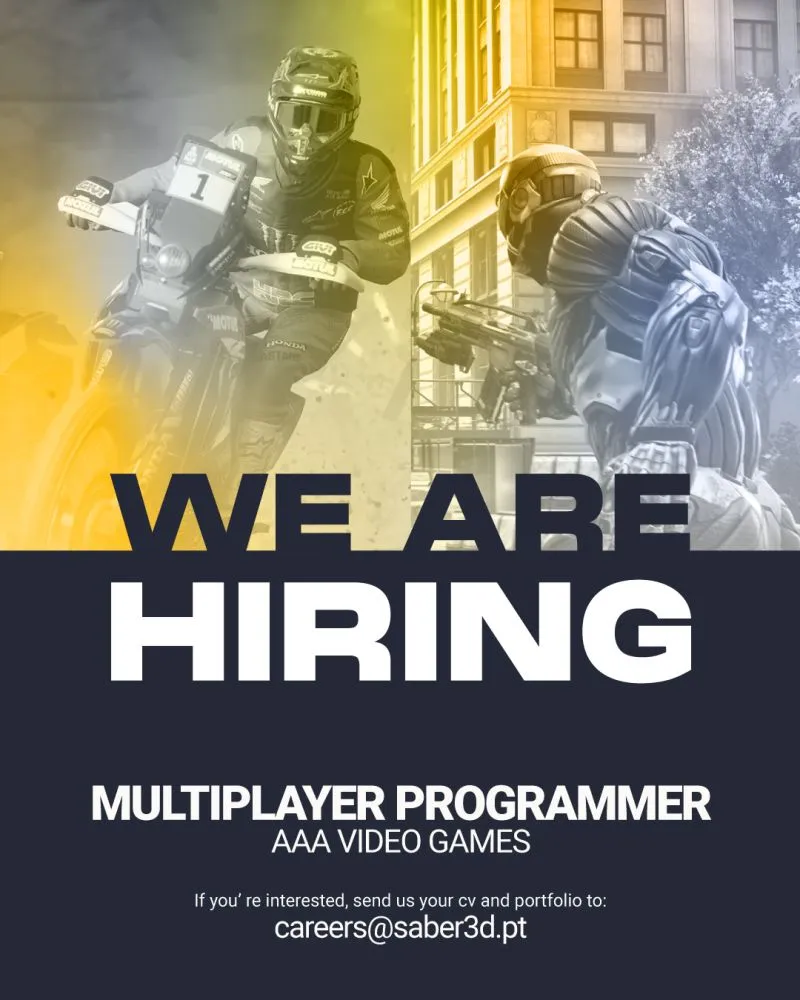
A Saber em Gaia procura um Multiplayer Programmer
+infos(oficial): LINK
Procura-se um Level Designer (Almada/Portugal) pela Kwalee, no modo híbrido, em que:
“Responsibilities
Collaborate with the creative team to develop and execute captivating interactive narratives for our game.
Utilise your strong understanding of cinematography and movie directing techniques to craft cinematic moments within the game.
Develop and maintain a deep understanding of the game’s narrative structure, characters, and world.
Script compelling dialogues, cutscenes, and interactive sequences that enhance the overall player experience.
Collaborate with other designers, artists, and programmers to ensure a seamless integration of storytelling elements into gameplay mechanics.
Conduct playtesting and iterate on the game’s storytelling elements based on feedback and player experience.
Stay up-to-date with the latest trends and advancements in interactive storytelling, cinematography, and game design to push the boundaries of our games
Requirements
Proven experience (minimum 3 years) in game development, with a focus on interactive storytelling and game design.
Strong scripting skills using industry-standard tools and languages.
Working knowledge of the Unity engine is a must.
Knowledge and understanding of cinematography principles, camera work, and movie directing techniques.
Excellent creative and storytelling abilities, with a keen eye for detail and an understanding of narrative structure.
Ability to effectively collaborate with multidisciplinary teams and communicate ideas clearly.
Strong problem-solving skills and the ability to adapt to changing project requirements.
Positive attitude, self driven and able to work alone or as part of a team.
Passion for video games, storytelling, and a deep understanding of player engagement.
Based in one of our office hubs, following our hybrid model with 3 days per week on-site.”
+infos(oficial): LINK
Procura-se um Game Economy Designer (Almada/Portugal) pela Kwalee, no modo híbrido, em que:
“Responsibilities
Working closely with designers and the analytics team to develop the right inputs, and measurements for evaluating a game’s economic patterns.
Creating models for various interpretations of the game economy and forecasting player behaviours to find the right global maxima approach.
Collaborate with the Art Leads to find the right information hierarchy and UI conventions to get information across to the user in a tone and style appropriate to each game.
Working with the analytics department to understand the results of your work and the impact it has on player behaviour.
From paper to playable you will be able to visualise the desired UX, both in UX tools or in Unity.
Providing feedback based on your expertise on a wide range of games.
Requirements
A minimum of 2 years experience in an economy design or balancing role within gaming.
Can create models in industry standard tools to model player behaviours and the resultant economy impacts of those.
Can devise the parameters and measurements for effective AB testing of game economy variations.
Experience of mobile game live ops, A/B testing and analytics.
Strong written and verbal communication skills.
Ability to work creatively in a demanding team environment.
Absolute passion for playing and making video games, especially mobile games.
Strong creative ideas and imagination, able to entertain players with challenges, humour, surprises and fun.
Positive attitude, self driven and able to work alone or as part of a team.”
+infos(oficial): LINK
Procura-se um Senior Game Designer (Almada/Portugal) pela Kwalee, no modo híbrido, em que:
“Responsibilities
Working as part of the design team and working closely with them to make our games as fun as they can be.
Taking responsibility for multiple mobile game projects, creating game design documents, diagrams and flowcharts.
Designing compelling game mechanics using modern mobile design principles.
Creating, balancing and tuning game mechanics, game difficulty and UI flow.
Creating levels and additional content using Unity, for new and existing games.
Evolving and adapting game designs based on play testing, feedback and live metrics.
Driving long term player engagement by understanding mobile players needs and motivations.
Requirements
A minimum of 5 years experience in a game design role with at least one published relevant game.
Strong written and verbal communication skills.
Knowledge of mobile free-to-play game monetisation and advertising techniques.
Ability to work creatively in a demanding team environment.
Absolute passion for playing and making video games, especially mobile games.
Strong creative ideas and imagination, able to entertain players with challenges, humour, surprises and fun.
Positive attitude, self driven, able to work alone or as part of a team.”
+infos(oficial): LINK
Global Game Jam 2024 (1ª edição do ano)

Vai decorrer entre os dias 22 e 28 de janeiro a primeira edição do evento mundial Global Game Jam. Este ano e em Portugal existem eventos organizados nas seguintes localidades:
Porto – LINK
Porto – LINK
Aveiro – LINK
Covilhã – LINK
Leiria – LINK
Porto Salvo – LINK
Lisboa – LINK
Lisboa – LINK
Carnaxide – LINK
Almada – LINK
Faro – LINK
Os eventos são gratuitos, não decorrem todos os dias, dependendo da proposta de cada organizador :)
+infos(oficial): https://globalgamejam.org/